
“Organic Farming 360°: Trends, Tools, and Tips to Grow Naturally & Profit Big”

Table of Contents
- 1. Introduction
- 2. What is Organic Farming ?
- 3. Why Organic Farming is Gaining Importance Across the Globe ?
- 4. What are the Core Principles of Organic Farming ?
- 5. What are the Thumb Rules for the Success of Organic Farming ?
- 6. Getting Started with Organic Farming
- 7. What are the Government Schemes Available for Organic Farming in India ?
- 8. Organic Certification: The What, Who, and How
- 9. Marketing Organic Produce
- 10. Inputs & Tools for Organic Farming
- 11. Conclusion
- 12. Frequently Asked Questions (FAQ) on Organic Farming
1. Introduction
Organic farming is rapidly transforming agriculture worldwide, offering sustainable solutions that benefit both the environment and consumers. This comprehensive guide delves into the essentials of organic farming, providing insights into its principles, benefits, practical steps, global statistics, affiliate resources, and future trends. Whether you’re a budding farmer, eco-conscious consumer, this article equips you with everything you need to succeed.
2. What is Organic Farming ?
Organic farming emphasizes cultivating crops and raising livestock using natural processes, avoiding synthetic chemicals, genetically modified organisms (GMOs), and artificial fertilizers. This method prioritizes soil health, biodiversity, and ecological balance.
Comparison Table: Organic vs. Farming using Chemicals
| Aspect | Organic Farming | Farming Using Chemicals |
| Soil Fertility | Enhanced with compost & cover crops | Depleted by synthetic fertilizers |
| Pest Management | Biopesticides, neem, biodiversity | Chemical pesticides |
| Crop Yield | Initially low, improves over time | High but environmentally taxing |
| Environmental Impact | Promotes biodiversity, low pollution | Contributes to pollution & erosion |
Global and Indian Organic Farming Trends
- Global: As of 2023, the global organic farming area reached ~99 million hectares, marking a 2.6% increase. The market for organic products has surpassed $150 billion.
- India: By March 2023, India had over 10.17 million hectares under organic certification and more than 4.43 million organic farmers—the highest globally.
Comparison Table: Organic Farming vs. Other Sustainable Methods
| Feature | Organic Farming | Natural Farming | Regenerative Farming | Permaculture |
| Use of Chemicals | Avoids synthetic chemicals | Strictly avoids all chemicals | Minimizes chemical use | Avoids synthetic inputs |
| Certification | Required | Not required | Optional | Not required |
| Focus Area | Soil health, biodiversity | Natural processes & biodiversity | Soil regeneration & carbon sequestration | Holistic systems design |
| Popular Regions | Worldwide | India | North America & Europe | Global |
3. Why Organic Farming is Gaining Importance Across the Globe ?
- Environmental Protection
Organic farming avoids synthetic chemicals and emphasizes natural inputs, leading to reduced soil and water pollution, better soil structure, improved water retention, and enhanced biodiversity. - Health and Food Safety
With rising concerns about pesticide residues and genetically modified organisms (GMOs), consumers are increasingly choosing organic products for their natural composition and potential nutritional benefits. - Economic Opportunities for Farmers
Organic produce often commands premium prices in both local and international markets. Lower input costs over time and support through government schemes make it a profitable venture for many farmers. - Growing Global Demand
The global organic food market has exceeded $150 billion and continues to grow rapidly. This consumer-driven demand is pushing farmers, retailers, and governments to expand organic agriculture. - Climate Change Mitigation
Organic farming methods increase soil organic carbon, reduce greenhouse gas emissions, and eliminate dependence on fossil-fuel-based fertilizers—making it a climate-smart approach to agriculture. - Ethical and Social Responsibility
The movement supports fair trade practices, animal welfare, local farming systems, and sustainable rural development, aligning with global calls for responsible and inclusive food systems.
4. What are the Core Principles of Organic Farming ?
Core Principles of Organic Farming, as defined by the International Federation of Organic Agriculture Movements (IFOAM) — the global authority on organic standards. Organic farming is built upon four interrelated principles that guide all practices, decisions, and philosophies behind the method.
- The Principle of Health
- The Principle of Ecology
- The Principle of Fairness
- The Principle of Care
1. The Principle of Health
“Organic agriculture should sustain and enhance the health of soil, plant, animal, human, and planet as one and indivisible.”
- Focuses on holistic well-being, not just disease prevention
- Promotes chemical-free, nutrient-dense food
- Ensures long-term soil and ecosystem health
2. The Principle of Ecology
“Organic agriculture should be based on living ecological systems and cycles, work with them, emulate them, and help sustain them.”
- Farming should mimic natural ecosystems
- Encourages biodiversity, crop rotation, and closed-loop systems
- Builds resilience and environmental sustainability
3. The Principle of Fairness
“Organic agriculture should build on relationships that ensure fairness with regard to the common environment and life opportunities.”
- Respect for farmers’ rights, fair wages, and safe working conditions
- Ethical treatment of animals and land
- Supports social justice and local food systems
4. The Principle of Care
“Organic agriculture should be managed in a precautionary and responsible manner to protect the health and well-being of current and future generations and the environment.”
- Avoids risky technologies like GMOs and harmful chemicals
- Emphasizes responsible innovation and risk management
- Encourages long-term thinking over short-term profit
5. What are the Thumb Rules for the Success of Organic Farming ?
- Soil Health Management: Utilizing natural compost and green manure to enrich soil fertility.
- Crop Diversification: Implementing crop rotation and intercropping to enhance biodiversity and reduce pests
- Biological Pest & Disease Control: Employing natural predators and organic pesticides to manage pests.
- Prohibition of GMOs: Avoiding genetically modified organisms to maintain ecological balance.
1. Soil Health Management
Soil health is the foundation of productive farming. A critical component of soil health is soil organic carbon (SOC). It’s the carbon component of organic matter which influences soil structure, fertility, microbial activity and water retention. Organic farming practices, such as composting and cover cropping, enhance SOC levels, leading to
- Improved Soil Fertility: Higher SOC supports robust microbial activity, essential for nutrient cycling.
- Enhanced Water Retention: Organic-rich soils retain moisture better, reducing irrigation needs.
- Carbon Sequestration: Increased SOC helps mitigate climate change by capturing atmospheric CO₂.
Affiliate Recommendation: To monitor and improve your soil’s health, consider using a reliable soil testing kits like Soil Moisture Meter, Basic Soil Test Kit on Amazon
What is the Optimum Soil Organic Carbon (SOC) Level for Farming?
| Soil Type / Use | Optimum SOC (%) |
| Productive Agricultural Soil | 1.5% – 3% |
| Grasslands or Forest Soils | >3% |
| Dryland Soils (India typical) | 0.5% – 1.5% (aim to reach 1.5%) |
⚠️ Below 0.5% is considered depleted/poor soil, especially for crop production.
Soil Organic Carbon Levels in India (Pre & Post–Green Revolution)
- Before the Green Revolution (~1960s):
- Estimated average SOC in Indian agricultural soils was ~1.5% or higher.
- Traditional organic practices like crop rotation, farmyard manure, cow dung composting, and cover crops kept SOC in a healthy range.
- After Green Revolution:
- Due to excessive use of chemical fertilizers, monocropping, and poor organic matter return SOC dropped significantly.
- In many regions, it now hovers between 0.3% to 0.6% — critically low.
Affiliate Pick: [Soil Test Kit on Amazon]
| Tool | Purpose | Buy Link (Affiliate) |
|---|---|---|
| Soil pH Meter | Measures soil acidity/alkalinity | Buy on Amazon |
| Soil Test Kit (NPK + pH) | Tests nitrogen, phosphorus, potassium & pH | Buy on Amazon |
| Digital Soil Moisture Meter | Checks soil moisture levels | Buy on Amazon |
| EC & TDS Meter | Measures soil salinity and nutrients | Buy on Amazon |
| Portable Soil Analyzer | Advanced multi-parameter tester | Buy on Amazon |
2. Crop Diversification
Crop diversification is a core principle of organic farming that involves growing a variety of crops on the same farm either in sequence (crop rotation) or simultaneously (intercropping, mixed cropping). It helps maintain soil fertility, prevent pest and disease buildup, and promote resilience.
Why Crop Diversification is Essential in Organic Farming ?
| Benefit | Explanation |
| Soil Health Improvement | Different crops contribute various nutrients, reducing dependency on external inputs. Legumes fix nitrogen; deep-rooted crops improve aeration. |
| Pest & Disease Management | Breaks the lifecycle of pests and diseases that thrive on monoculture. |
| Biodiversity | Encourages natural predators and pollinators, stabilizing the agro-ecosystem. |
| Climate Resilience | Diverse crops reduce the risk of complete failure due to weather events or pests. |
| Income Stability | Multiple crops = multiple revenue sources. Farmers are less vulnerable to market fluctuations. |
Major Types of Crop Diversification in Organic Systems
- Crop Rotation
- E.g., Paddy → Legumes → Oilseeds
- Prevents nutrient depletion and suppresses weeds and diseases
- Intercropping
- E.g., Maize + Cowpea, Sugarcane + Marigold
- Maximizes space, suppresses weeds, and attracts beneficial insects
- Mixed Cropping
- Growing more than one crop simultaneously on the same land (e.g., wheat + mustard)
- Agroforestry
- Integration of trees with crops (e.g., mango + turmeric) enhances biodiversity and productivity
- Crop-Livestock Integration
- Crop residues feed animals; manure returns nutrients to soil
3. Biological Pest & Disease Control
In organic farming, pest and disease management relies on natural, preventive, and eco-friendly methods rather than synthetic pesticides. The goal is to create a balanced ecosystem where pests and pathogens are kept under control without harming beneficial organisms, soil health, or human safety.
Key Principles of Organic Pest & Disease Management
- Prevention is Priority
Healthy plants grown in fertile, balanced soil are naturally more resistant to pests and diseases. - Ecosystem-Based Control
Encourages beneficial insects, predators, and natural pest enemies. - Diversity
Crop diversification and rotation help break pest and disease cycles. - Non-Toxic Solutions
Use of botanicals, biopesticides, and mechanical methods instead of chemicals.
Common Organic Pest Control Methods
| Method | Description / Example |
| Botanical Sprays | Neem oil, garlic-ginger extract, chilli spray to deter chewing and sucking pests |
| Biopesticides | Bacillus thuringiensis (Bt), Trichoderma, Beauveria bassiana for caterpillars, fungi, and aphids |
| Companion Planting | Basil near tomatoes repels thrips; marigold with cabbage deters nematodes |
| Pheromone Traps | For mass-trapping of pests like fruit fly, pink bollworm |
| Sticky/Light Traps | Yellow/blue sticky traps or solar-powered light traps for flying insects |
| Mechanical Control | Handpicking, pruning, or using nets/barriers to protect crops |
| Cultural Practices | Timely sowing, intercropping, and clean harvesting reduce pest pressure |
Organic Disease Control Measures
| Practice | Purpose |
| Crop Rotation | Breaks disease cycles in soil-borne pathogens |
| Use of Resistant Varieties | Naturally resists certain bacterial/fungal infections |
| Solarization | Covering soil with plastic to kill pathogens using heat |
| Biocontrol Agents | Trichoderma harzianum, Pseudomonas fluorescens suppress fungal/bacterial diseases |
| Sanitation | Remove infected plants, disinfect tools regularly |
Homemade Organic Pest Sprays (DIY)
- Neem Oil Spray
- Mix 5 ml neem oil + 1 liter water + 2-3 drops of soap
- Effective against aphids, mites, whiteflies
- Chilli-Garlic Extract
- Blend chilli + garlic + water, let sit 24 hrs, strain
- Spray against chewing pests
- Buttermilk Spray
- Dilute buttermilk 1:4 with water
- Helps prevent powdery mildew on vegetables
⚠️ Organic Does NOT Mean Pest & Disease -Free
Instead, organic farming focuses on balance, monitoring, and resilience, not extermination.
Best Practices:
- Keep pest logs and regularly monitor fields
- Integrate multiple methods (IPM approach)
- Always test homemade sprays on a few plants before full use
- Maintain habitat for natural predators like ladybugs, spiders, and frogs
4. Prohibition of Genetically Modified Organisms (GMOs)
1.Strict Ban:
Organic farming regulations globally prohibit the use of genetically modified organisms (GMOs) at every stage — from seed to final product. Ex: Use of BT Cotton/Brinjal is not allowed in organic farming
2. Preserving Natural Integrity:
Organic systems prioritize natural genetic diversity and traditional breeding methods, avoiding artificial genetic modifications.
3. Biodiversity Protection:
By rejecting GMOs, organic farming helps protect ecosystems and native species from genetic contamination.
4. Consumer Trust and Certification:
Organic certification guarantees that products are 100% GMO-free, reinforcing consumer confidence and brand value.
5. Sustainable Philosophy:
Organic farming follows a sustainability-first approach, where respecting natural processes is central, making GMOs fundamentally incompatible.
6. Getting Started with Organic Farming
- Look for Govt. Schemes: Government Schemes are the best to start with
- Land Selection: Choose land with a history of minimal chemical use to ease the transition.
- Crop Selection: Opt for crops suited to your region’s climate and soil conditions.
- Organic Inputs: Source certified organic seeds and natural fertilizers.
- Certification Preparation: Familiarize yourself with certification requirements to ensure compliance from the outset
Affiliate Recommendation: Starting with a home composting system can be an excellent way to produce organic fertilizer. DIY Home Compost Kit on Amazon
7. What are the Government Schemes Available for Organic Farming in India ?
| Scheme Name | Launched By | Purpose / Focus Area | Source / Website Link |
|---|---|---|---|
| Paramparagat Krishi Vikas Yojana (PKVY) | Ministry of Agriculture & Farmers Welfare | Promote cluster-based organic farming (20 ha per cluster); financial assistance to farmers | Visit PKVY Official Site |
| Mission Organic Value Chain Development for North Eastern Region (MOVCDNER) | Ministry of Agriculture & Farmers Welfare | Develop certified organic production and linked value chains in North Eastern Region | Visit MOVCDNER Official Site |
| National Programme for Organic Production (NPOP) | APEDA, Ministry of Commerce & Industry | Set standards, certification system, and promotion of organic products for exports | Visit NPOP Official Site |
| Rashtriya Krishi Vikas Yojana (RKVY) – Organic Farming Component | Ministry of Agriculture & Farmers Welfare | Financial support to states for promoting organic farming projects | Visit RKVY Official Site |
| National Mission for Sustainable Agriculture (NMSA) | Ministry of Agriculture & Farmers Welfare | Promote sustainable agriculture practices including organic farming and soil health | Visit NMSA Official Site |
| Jaivik Kheti Portal | Ministry of Agriculture & Farmers Welfare | E-commerce platform for organic farmers to sell produce directly to consumers | Visit Jaivik Kheti Portal |
| Fertilizer Subsidy Scheme for Organic Inputs | Ministry of Chemicals and Fertilizers | Subsidize production and use of organic fertilizers like biofertilizers and compost | Visit Fertilizer Department Site |
PKVY and MOVCDNER are the biggest flagship programs offering direct financial help to organic farmers.
NPOP certification is necessary for exports under APEDA.
Jaivik Kheti portal helps farmers sell produce without middlemen.
8. Organic Certification: The What, Who, and How
Achieving organic certification authenticates your farming practices:
Why Certification Matters ?
1. Builds Trust & Increases Market Value Organic certification assures consumers that the product is genuinely organic, leading to higher credibility and premium pricing.
2. Ensures Standards & Legal Compliance It guarantees that farming practices meet strict organic, environmental, and health regulations, avoiding legal issues and ensuring consistency.
3. Opens Doors to Bigger Markets Certified products gain access to export channels, retail shelves, and organic-specific marketplaces—giving farmers a competitive edge.
What are the National and the International Organic Certification Standards ?
| Region/Country | Certification Standard | Administering Body |
|---|---|---|
| India | NPOP (National Programme for Organic Production) | APEDA – Agricultural and Processed Food Products Export Development Authority |
| USA | USDA Organic | USDA NOP – United States Department of Agriculture – National Organic Program |
| European Union | EU Organic Regulation | European Commission – Directorate-General for Agriculture and Rural Development |
| Global Reference | IFOAM Basic Standards | IFOAM – International Federation of Organic Agriculture Movements |
| Canada | COR (Canada Organic Regime) | CFIA – Canadian Food Inspection Agency |
| Japan | JAS (Japan Agricultural Standard) | MAFF – Ministry of Agriculture, Forestry and Fisheries |
| China | GB/T 19630 (China Organic Standard) | CNCA – Certification and Accreditation Administration of China |
Organic Certification Process in India (Step-by-Step)
India recognizes two main certification systems for organic agriculture, depending on the purpose and scale:
1. Participatory Guarantee System (PGS-India)
Community-based and suitable for small farmers. It’s either free or involves minimal administrative fees. Ideal for local sales and recognized under India’s organic farming framework
- Managed by: National Centre of Organic Farming (NCOF)
- Cost: Free or minimal
- Where it applies: Domestic/local markets only (not for export)
2. National Programme for Organic Production (NPOP)
Best for: Commercial-scale farmers, exporters
- Managed by: APEDA (Agricultural and Processed Food Products Export Development Authority)
- Recognized internationally: By USDA, EU, Japan, etc.
- Required for: Exporting organic products outside India
Steps in Organic Certification (Both PGS-India & NPOP Systems)
| Step | Details |
|---|---|
| 1. Application | Submit details about your land, crops, past input use, etc. to certifier or local PGS group |
| 2. Transition Period | Begin 2–3 year conversion process from conventional to organic methods |
| 3. On-Farm Inspection | Trained inspectors verify organic practices, documents, input usage |
| 4. Record Keeping | Maintain logs of all farming activities, inputs used, and crop cycles |
| 5. Certification Decision | Based on compliance, certification is granted by agency or PGS group |
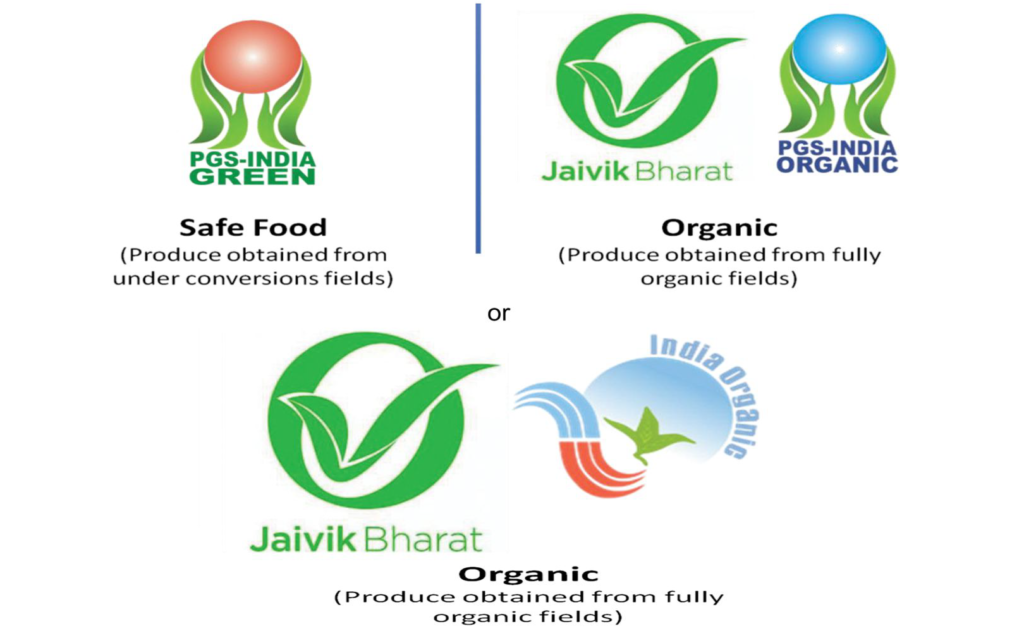
| 6. Logo & Labelling | Once certified, farmers can use PGS-India or India Organic logos |
Documents Required:
- Land ownership documents or lease papers
- Field history and input use record
- Farm map and boundary details
- Crop rotation and pest management plans
- Input purchase receipts (if any)
Cost Breakdown for obtaining NPOP Organic Certification
| Cost Item | Approximate Amount |
|---|---|
| Application Fee | ₹1,000–₹2,000 |
| Inspection Charges | ₹10,000–₹25,000/year |
| Certification Fee | ₹5,000–₹15,000/year |
| Total (Typical) | ₹25,000–₹50,000 annually |
Important Tips for Organic Certification:
- Start documentation from day one of conversion.
- Use only approved organic inputs (check with your certifier).
- Maintain clean boundaries to prevent chemical drift from neighboring farms.
- Join a local organic farmers group or NGO for support and training.
Labelling of Organic Certified Products in India
Affiliate Tip: To simplify certification prep, consider using a farm management app or record-keeping notebook: Buy Farm Record Keeping Book on Amazon
9. Marketing Organic Produce
Online Marketing Platforms in India for Organic Produces
| Platform | Details | Link |
|---|---|---|
| BigBasket (Organic Section) | Lists organic fruits, veggies, groceries. | bigbasket.com |
| Amazon Fresh | You can register as a seller of fresh organic produce. | sell.amazon.in |
| Flipkart Grocery | Accepts organic pantry and grocery items. | seller.flipkart.com |
| Organic India | Potential supplier tie-ups for certified farms. | organicindia.com |
| Farmizen (India) | Connects organic farmers directly to urban consumers. | farmizen.com |
10. Inputs & Tools for Organic Farming
| Standard Manure Requirement for Organic Farming (Per Acre) | |||
| Type of Manure | Quantity per Acre | Average Organic Carbon (%) | Application Tips |
| Farmyard Manure (FYM) | 5–10 tons (5,000–10,000 kg) | 0.5% – 1.5% | Apply 2–3 weeks before sowing; ensure it’s decomposed |
| Compost | 2–5 tons | 1.5% – 2.5% | Well-decomposed; enrich with bio-activators if needed |
| Vermicompost | 1–2 tons | 2% – 3% | Rich in nutrients & microbes; use closer to root zone |
| Green Manure (e.g. Dhaincha) | Incorporated as live biomass | ~0.8% – 1.5% | Grown and ploughed into the soil before flowering |
| Cow Dung Slurry / Jeevamrut | 20–200 L per acre (diluted) | ~0.3% – 0.5% | Apply weekly/bi-weekly as liquid biofertilizer |
| Input Name | Recommended Quantity per Acre | Application Stage | Dilution Ratio | Application Frequency |
|---|---|---|---|---|
| Panchagavya | 20–25 liters | Foliar spray & soil drench (vegetative, flowering) | 1:10 (1L in 10L water) | Every 15 days or 3–4 times per crop cycle |
| Panchamruta | 5–10 liters | Seedling treatment, flowering enhancer | 1:10 to 1:15 | 1–2 times per crop cycle |
| Jeevamruta | 200 liters | Soil microbial enrichment, basal soil drench | No dilution (already liquid form) | Every 7–15 days or after irrigation |
| Beejamruta | 5–10 liters (for seeds) | Seed treatment only | Enough to coat seeds | Once before sowing |
| Amritpani | 200 liters | Soil application at sowing or transplant | No dilution (mixed during prep) | Once or twice during initial crop stages |
| Ghanya Jeevamrut | 200 liters | Spray or soil drench for cereals (like paddy) | Can be diluted 1:2 | 2–3 times per season |
| Fish Amino Acid (FAA) | 5 liters | Foliar application for nitrogen boost | 1:100 (10 ml in 1L water) | Every 10–15 days during vegetative phase |
| Banana Pseudostem Extract | 20 liters | Potassium & sugar source during flowering | 1:10 | Once or twice during flowering |
Subhash Palekar Natural Farming (SPNF) Guidelines: https://naturalfarming.niti.gov.in
ICAR – Indian Council of Agricultural Research: https://icar.org.in
TNAU Agritech Portal – Organic Farming Section: https://agritech.tnau.ac.in/org_farm/orgfarm_index.html
NCOF – National Centre of Organic Farming: https://ncof.dacnet.nic.in
Affiliate Picks:
| Tool | Purpose | Buy Link (Affiliate) |
|---|---|---|
| Wireless Weather Station | Tracks temperature, humidity, rainfall | Buy on Amazon |
| Digital Rain Gauge | Measures rainfall accurately | Buy on Amazon |
| Anemometer (Wind Meter) | Measures wind speed | Buy on Amazon |
| UV Index Meter | Monitors sunlight intensity | Buy on Amazon |
| Tool | Purpose | Buy Link (Affiliate) |
|---|---|---|
| Drip Irrigation Kit | Efficient water delivery | Buy on Amazon |
| Solar Water Pump | Eco-friendly irrigation | Buy on Amazon |
| Battery Sprayer | For applying organic pesticides | Buy on Amazon |
| Agricultural Drone | Crop monitoring and spraying | Buy on Amazon |
| Farm Management App | Tracks inputs, yield, and weather | Download |
11. Conclusion
Organic farming is more than a method—it’s a movement. With the right strategy, tools, and mindset, you can build a profitable and sustainable farming business over a period of time.
Start Today: Test your soil, build a compost pile, and tell your farm’s story online!
12. Frequently Asked Questions (FAQ)
❓ What is organic farming in simple terms?
Organic farming is a method of growing crops and raising animals without using synthetic chemicals, GMOs, or artificial fertilizers. It focuses on natural processes to protect soil health, biodiversity, and the environment.
❓ Is organic farming profitable?
Yes, organic farming can be highly profitable due to premium product pricing, lower long-term input costs, and growing market demand. Success depends on crop selection, marketing, and proper certification.
❓ How can I get certified as an organic farmer in India?
You can get certified through PGS-India or NPOP. The process includes application, inspection, a 2–3 year transition period, and documentation.
❓ What crops are best for organic farming in India?
Pulses, spices like turmeric, millets, organic cotton, and fruits like banana and papaya are excellent options for organic farming in India.
❓ Can I start organic farming at home?
Yes, you can start with a small space using compost soil, organic seeds, and natural pest control. Herbs, vegetables, and even fruits can be grown organically at home.